
Why Trying to Stop Your Maladaptive Daydreaming Isn't Enough (And What to Do Instead)
Practical understanding around triggers and why immersion is coping with emotions
MALADAPTIVE DAYDREAMINGINFOGRAPHIC
Dr Wanda Fischera
4/9/20266 min read


If you've ever tried to get a handle on your daydreaming, you've probably tried to identify your triggers. Track when it happens. Notice the pattern. Avoid the music, the certain films, the quiet room.
And you've probably found that this doesn't really work, or at least, not for long.
That's not because you're doing it wrong. It's because triggers are only part of the picture. Understanding what's underneath them changes everything.
What We Usually Mean by "Triggers"
In most advice about maladaptive daydreaming (MD), triggers are described as external cues — the song that pulls you straight into a daydream, the moment of boredom, the specific environment. These are real. They matter. But treating them as the primary cause of MD is a bit like treating a smoke alarm as the problem when there's a fire.
The alarm is real. But what's behind it?
Triggers Are Emotional Events, Not Just Situations
What most trigger-focused advice misses is that the situations themselves are rarely the problem. What matters is the emotional response those situations activate.
A song doesn't make you daydream. What the song does is shift your emotional state, and it's that shift that pulls you toward daydreaming when your mind is not occupied by something interesting or you can’t focus because of a trigger.
Loneliness, rejection, overwhelm, boredom, shame, anxiety — these are the actual triggers. The music, the film, the quiet room are the routes in. They work because they reliably activate a particular emotional state, and your mind has learned that daydreaming is a fast, effective way to respond to that state.
This is why avoiding triggers has limited power. You can remove the song. You cannot remove the emotion.
Why Daydreaming Works So Well as an Emotional Response
To understand why MD is so hard to change, it helps to understand what it's actually doing for you: and it is doing something. That's not a criticism. It's the most important thing to understand about it.
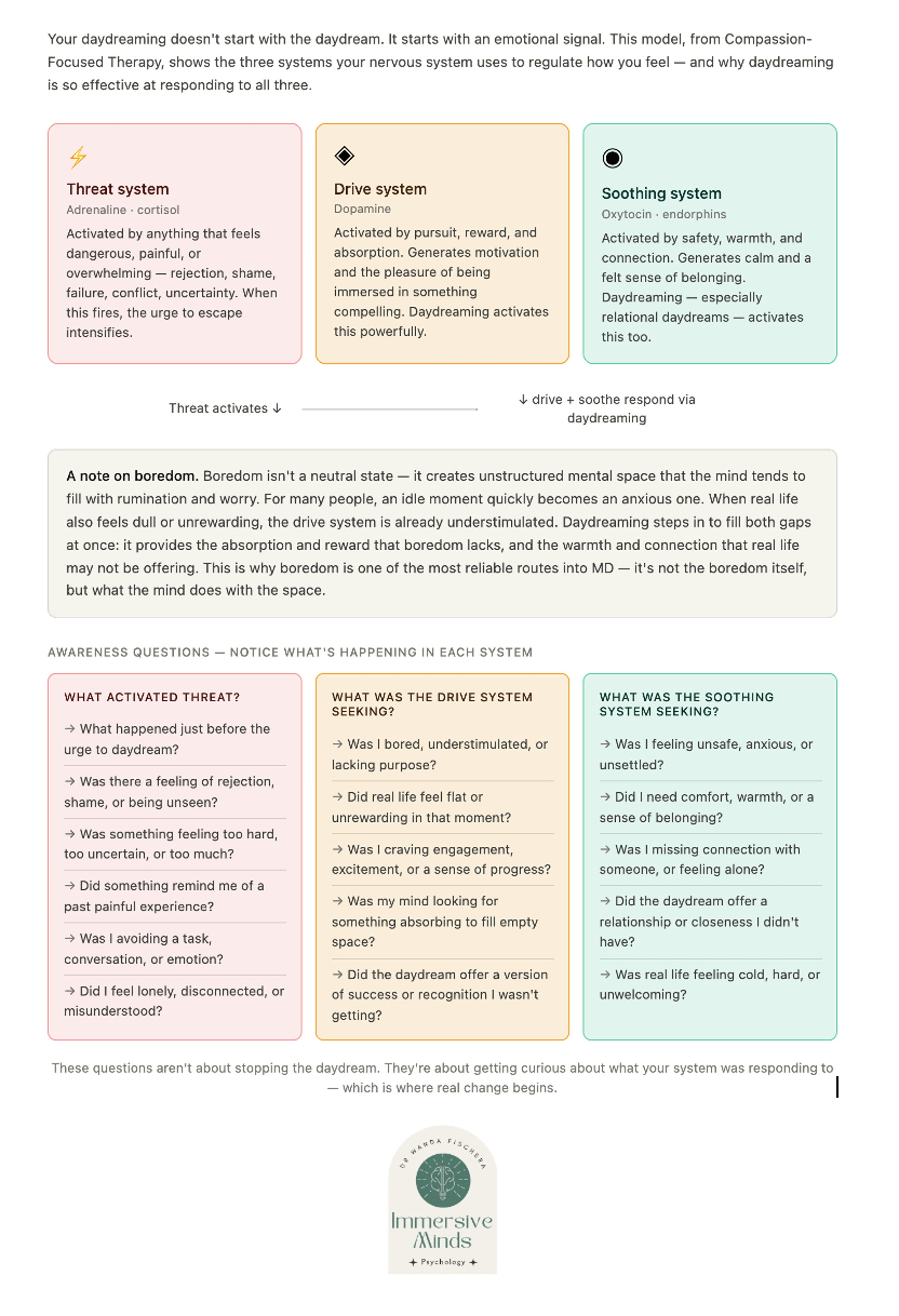
Compassion-Focused Therapy (CFT) describes three emotional systems that all humans use to regulate how they feel. Each system has a distinct function and a distinct neurochemical signature.
The threat system is activated by anything perceived as dangerous, painful, or overwhelming — whether that's a difficult conversation, a feeling of rejection, or a wave of shame. When the threat system fires, the body responds: heart rate increases, thinking narrows, the urge to escape intensifies.
The drive system is activated by pursuit, achievement, and reward. It generates motivation, focus, and the particular pleasure of being absorbed in something. Dopamine is central to this system — it's what makes something feel compelling, worth pursuing, worth staying inside.
The soothing system is activated by safety, connection, and comfort. It generates feelings of warmth, calm, and belonging. Oxytocin plays a key role here, it's the neurochemical of felt connection and security.
See the diagram at the end of the blog.
Here's what this means for MD: when the threat system activates, when something in your real life feels too difficult, too painful, or too overwhelming, your mind goes looking for relief. And daydreaming is extraordinarily good at providing it, because it activates both the drive system and the soothing system simultaneously.
In the daydream, there is pursuit, narrative, absorption - drive. When in drive, you are so absorbed that it can override the emotion you were feeling beforehand. Or, for some, it amplifies the emotion, however, in a controlled, safe space. For example, anger may take you to a daydream where you are able to feel that emotion in fantasy, where anger is used to protect yourself and therefore can feel like you are not in threat anymore. There is connection, belonging, warmth in fantasy, as the majority of daydreams include characters, and therefore it offers soothing. The threat that activated in response to something real is quieted by moving into a state that feels genuinely better, as the fantasy and daydreams offer real emotions (more on this here).
This is not a flaw in your character. It is a very effective short-term emotional regulation strategy. The problem is not that it works. The problem is what it costs over time, and the fact that it has become the primary, or only, way your system knows how to respond to threat.
What This Means for Understanding Your Daydreaming
When you start to look at MD through this lens, a few things become clearer.
The urge to daydream is an emotional signal, not a failure of willpower. When the pull toward daydreaming intensifies, something has activated your threat system. The daydream is not the problem, it's the coping response. The question becomes: what was the threat?
The more effective daydreaming is at soothing, the harder it is to stop. If your daydreaming reliably provides the sense of connection, safety, or excitement that is harder to find in your real life, of course it will be compelling. If your daydreaming reliably activates the sense of drive and your focus sharpens when immersing yourself, it becomes something “addictive” that secretes dopamine, and almost nothing can measure up to its ability to distract, consume and deliver emotions that you seek.
This is also why the reality-fantasy gap is felt most, where daydream provides both soothing and excitement. Of course it will feel impossible to resist, especially because immersion can be accessible at any time.
This is not weakness. It is your nervous system doing exactly what it has learned to do.
Although part of the journey to reduce daydreaming is avoiding and then modifying triggers, it addresses the surface, not the system. Removing the song, the film, the quiet room removes one route into the emotional state. But the emotional state will find another route. Real change involves working with the underlying emotional system — learning to notice when threat activates, understanding what it's responding to, and gradually building other ways of meeting the needs that daydreaming currently meets.
What Helps: Working With the Emotional System, Not Against It
This is where a lot of well-meaning advice about MD goes wrong. It focuses on suppression: on stopping the daydream, limiting the time, avoiding the cues. Modifying the environment has an important role to reduce the period and depth of immersion, but on its own it doesn't address what the daydreaming is doing, or why. That is why people find it hard to maintain progress.
More sustainable change tends to involve a few things. This is slower, more uncomfortable work around understanding your tendency to avoid emotions, but it's the work that actually makes a difference where you build distress tolerance, awareness of emotions, learn to validate yourself and try new coping tools that may not feel as intense and quick-wins such as daydreaming, but help you on the long-run.
Building awareness of the emotional system underneath. Not just "I daydream when I'm bored" but "I daydream when I feel disconnected, or when I've had an interaction that left me feeling unseen, or when I'm facing something that feels too big that I want to avoid/escape/suppress/don’t think about."
Learning to tolerate the emotional state without immediately escaping it. This is not about forcing yourself to feel bad. It's about gradually extending the window of time between the emotional trigger and the daydream, building a little more capacity to be with what's there before moving away from it.
Building real-life sources of soothing and drive. This is perhaps the most underemphasised part of working with MD. If daydreaming is meeting needs that aren't being met elsewhere, the answer isn't simply to remove daydreaming. It's to slowly build a real life that offers some of what the daydream world provides; connection, safety, meaning, engagement and learning new tools to cope. Not a perfect life. A life that's worth being present in.
A Different Question to Ask
Most advice about MD starts with: how do I stop?
A more useful starting question might be: what is my daydreaming responding to? What is my daydreaming protecting me from?
Not as an exercise in self-blame. Not as a way to criticise yourself for something that has, in all likelihood, been protecting you for a long time. But as genuine curiosity about what your emotional system has been trying to do, and what it might need instead.
Understanding the emotional function of MD doesn't mean resigning yourself to it. It means you have somewhere real to work from towards sustainable change and self-understanding.
If you'd like to explore this further, my newsletter goes deeper into the emotional and psychological underpinnings of maladaptive daydreaming each month.
If you're ready to explore this with support, you can find out more about 1:1 therapy at Immersive Minds Psychology.
Support
Dr Wanda Fischera is offering personalised online therapy for individuals and groups. Registered with HCPC.
Connect & receive updates on services and free resources
© 2024. All rights reserved. By Dr Wanda Fischera
I respect your privacy and I will not pass on your details to third parties.